+8613776545860


Every year, civil engineers and project developers face a multi-billion-dollar challenge: concrete cancer.
When water, road salt, or ocean spray penetrates concrete, internal steel rebar rusts and expands, splitting the concrete from within. The result? Pricey repairs, structural safety risks, and shortened asset lifespans.
At Chemlead New Material Co., Ltd., we engineered a permanent alternative: Glass Fiber Reinforced Polymer (GFRP) Rebar.
Below, we examine how composite rebar works, where it outperforms steel, and why modern infrastructure projects are adopting GFRP for 100+ year design lives.
The Core Problem with Traditional Steel Rebar
Concrete is naturally porous. No matter how dense the pour, microscopic moisture pathways always exist. When carbon steel meets oxygen and moisture or chloride ions:
Oxidation Begins: The steel begins to corrode internally.
Volumetric Expansion: Rust expands up to 600% of the original steel volume.
Spalling & Failure: Micro-cracks turn into structural spalling, requiring costly restoration within 10 to 20 years.
How GFRP Rebar Changes the Game
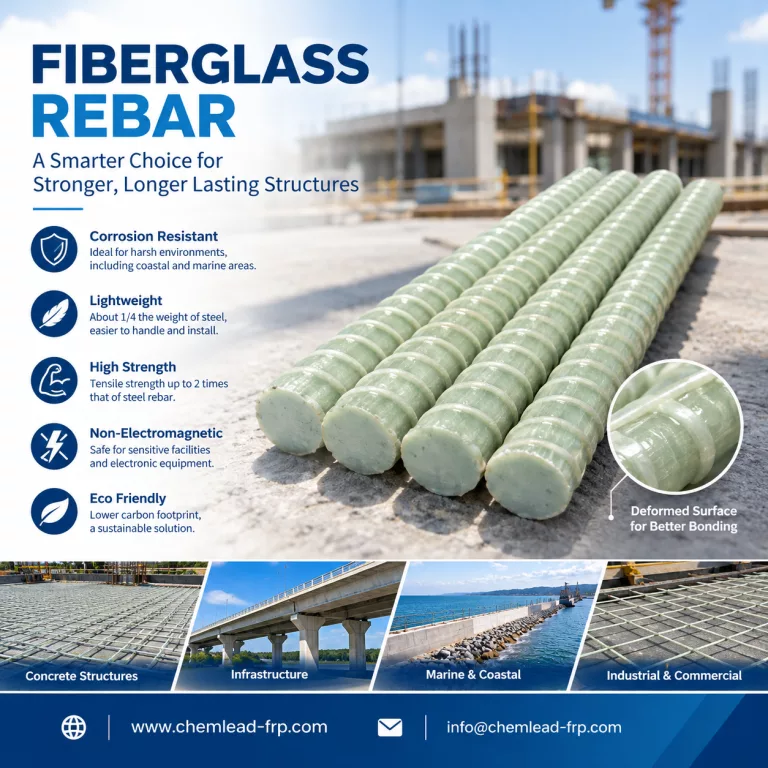
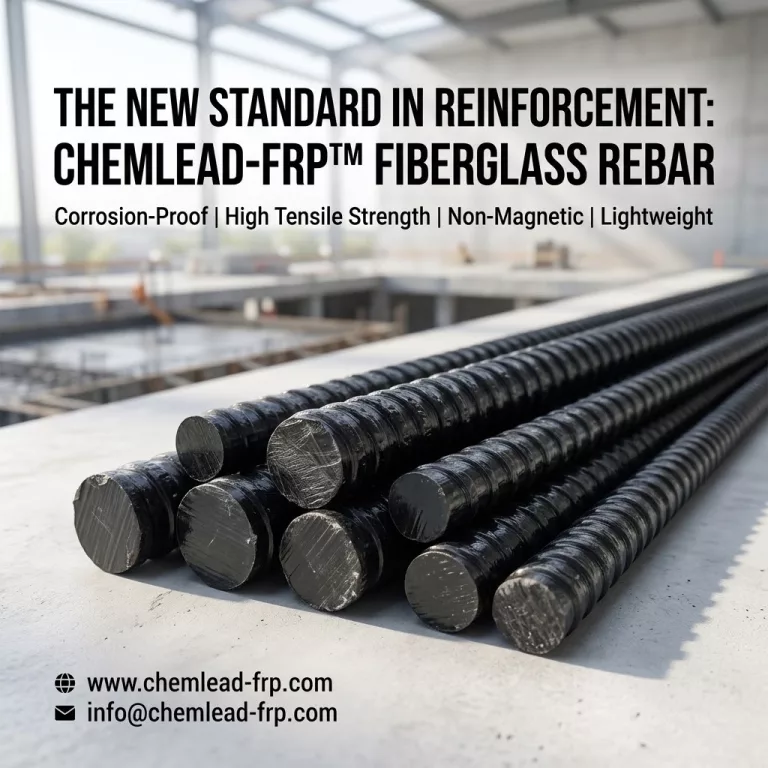
GFRP rebar replaces iron with ultra-strong glass filaments fused together inside a high-performance polymer resin matrix. Because there is zero metal inside, corrosion is impossible.
Key Performance Highlights
100% Corrosion Proof: Completely immune to salt spray, moisture, deicing chemicals, and aggressive acidic or alkaline soils.
4x Lighter Than Steel: Weighs just 25% of standard carbon steel, drastically cutting shipping costs and manual handling effort on job sites.
2x the Tensile Strength: Delivers over 1,000 MPa in tensile capacity—more than double grade 60 steel.
100% Non-Conductive: Non-magnetic and electrically non-conductive, protecting sensitive electronic environments.
100+ Year Service Life: Eliminates recurring repair budgets over the entire lifecycle of the structure.
Where GFRP Rebar Excels
Marine & Offshore Engineering
Sea walls, breakwaters, piers, docks, and coastal retaining walls exposed to saltwater spray.
Transportation & Bridge Infrastructure
Bridge decks, barrier walls, highway pavements, and tunnel linings subjected to winter deicing salts.
Wastewater & Chemical Plants
Water treatment basins, chemical containment tanks, and sewer vaults where reactive fluids corrode metals.
Electromagnetically Sensitive Facilities
Hospital MRI suites, high-voltage power substations, airport radar towers, automated toll booths, and data centers.
Strategic Comparison: GFRP vs. Carbon Steel
Corrosion Risk: Steel rusts under moisture; GFRP will never rust.
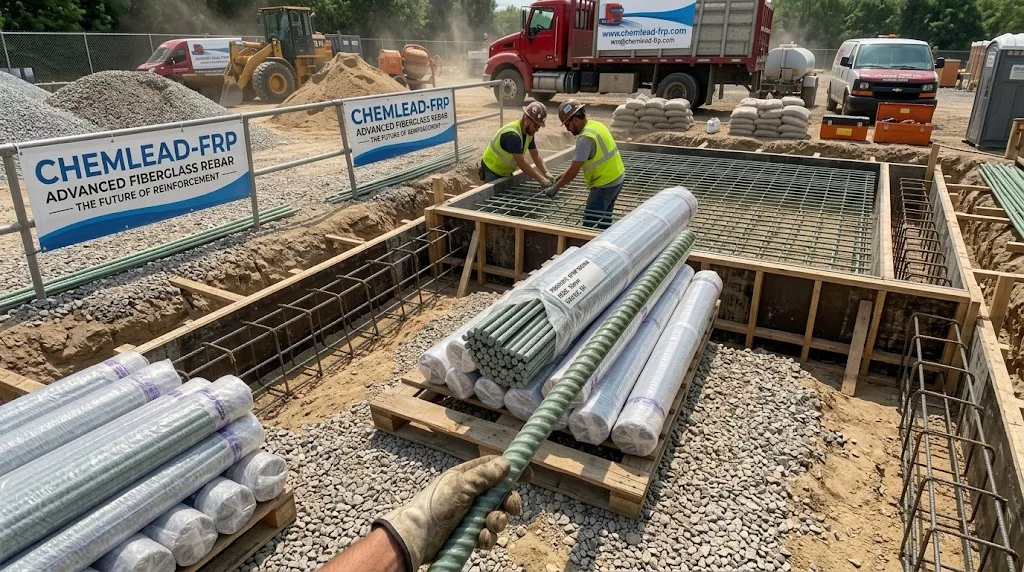
Weight: Steel requires heavy crane lifting; GFRP allows fast, hand-placed labor.
Electrical Conductivity: Steel conducts electricity and distorts magnetic fields; GFRP is completely neutral.
Maintenance Needs: Steel requires routine cathodic protection or sealing; GFRP is 100% maintenance-free.
Build Longer-Lasting Infrastructure with Chemlead
Don’t let corrosion dictate the lifespan of your structures. Switch to Chemlead New Material Co., Ltd. for certified, high-performance GFRP composite rebar tailored to your structural requirements.
📍 Headquarters: Nanjing, China
📩 Get in Touch: Contact our technical engineering team today to request product specifications, test reports, or custom project quotes.